This buying guide explains what you should confirm before placing a custom harness order: wire gauge, length tolerance, connector brand, terminal specification, insulation, protective sleeve, labeling, testing, packaging, compliance documents, and production approval workflow. It is written for engineers, purchasing managers, product developers, importers, and OEM sourcing teams looking for a custom harness assembly supplier, custom cable harness manufacturer, wire harness factory in China, or long-term OEM wiring harness partner.
The goal is simple: avoid vague specifications. Vague specifications create vague quotations, vague samples, and very specific headaches.
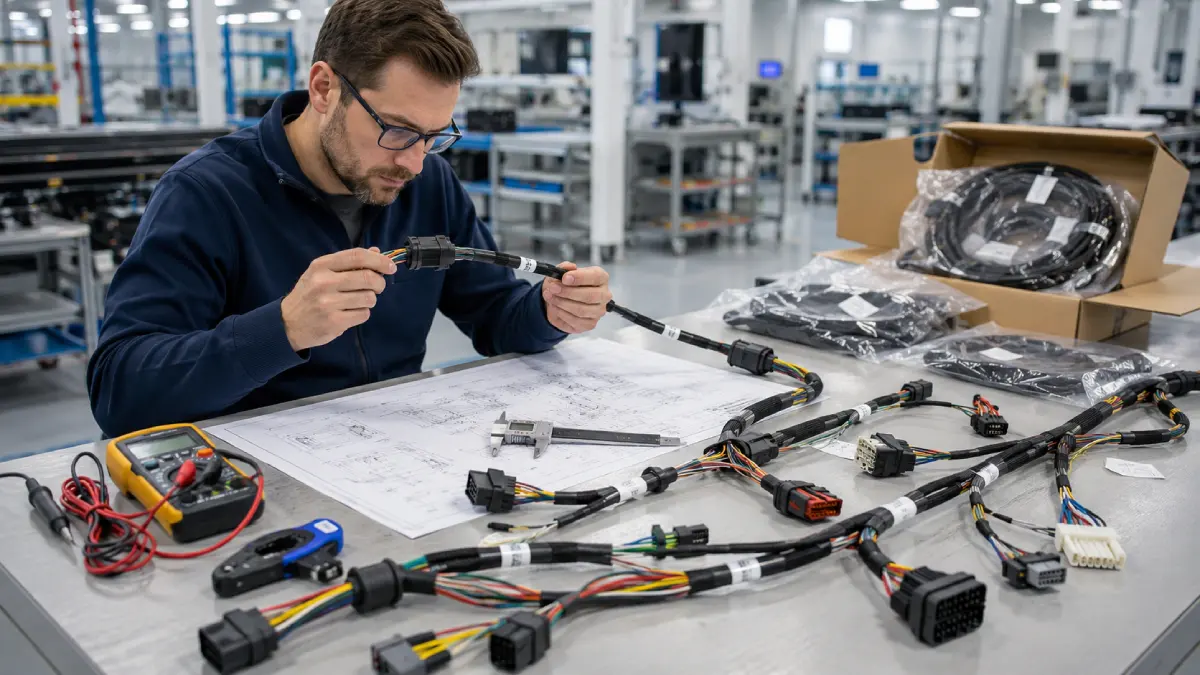
Why Custom Wire Harness Orders Fail Before Production Starts
Most harness problems do not begin on the production line. They begin during communication. Buyers often send a sample photo, a rough drawing, or a partial BOM and expect suppliers to quote accurately. Suppliers may then make assumptions about wire size, material grade, connector alternatives, shielding, length tolerance, packaging, or test requirements. When several suppliers quote based on different assumptions, the lowest price may not represent the same product at all.
A professional custom wire harness factory will ask questions before quoting. It will confirm application environment, wire specification, connector model, terminal type, branch length, pinout, current load, insulation rating, protective covering, label content, testing scope, packing method, and annual quantity. If a supplier gives a fast quote without asking technical questions, that is not efficient. That is gambling with a PDF attached.
Micro Summary: What Must Be Confirmed First
For any OEM or ODM harness order, the first round of confirmation should cover eight core areas: electrical load, conductor size, harness geometry, connector and terminal system, insulation and jacket material, mechanical protection, identification and traceability, and inspection method. These details determine cost, quality, safety, and production repeatability.
| Confirmation Area | What to Confirm | Risk If Ignored |
|---|---|---|
| Wire gauge | AWG or mm², current load, voltage, conductor material, strand structure. | Overheating, voltage drop, poor flexibility, safety risk, failed inspection. |
| Length and tolerance | Total length, branch length, measuring points, bend allowance, tolerance range. | Installation failure, strain on connectors, rework, assembly delay. |
| Connector brand | Original brand, part number, equivalent approval, mating connector information. | Mismatch, unstable connection, supply shortage, certification conflict. |
| Protection | Sleeving, conduit, heat shrink, braided sleeve, tape, grommet, strain relief. | Abrasion, moisture ingress, vibration damage, short service life. |
| Testing | Continuity, pinout, insulation resistance, Hi-Pot, pull force, visual inspection. | Wrong circuit, short circuit, loose terminal, field failure. |
Confirm Wire Gauge Before You Confirm Price
Wire gauge is one of the most important technical details in a custom wire harness. It affects current capacity, resistance, voltage drop, heat generation, flexibility, weight, material cost, crimping compatibility, and installation performance. If the gauge is too small, the harness may overheat or fail under load. If it is too large, the product may become unnecessarily expensive, stiff, heavy, and difficult to route.
Buyers often describe wire size using AWG, while many international drawings use square millimeters. Both can work, but the quotation must clearly state the conductor size, conductor material, strand structure, insulation thickness, voltage rating, and temperature rating. Do not allow the supplier to write only “red wire” or “black wire.” That is not a specification; that is a color preference.
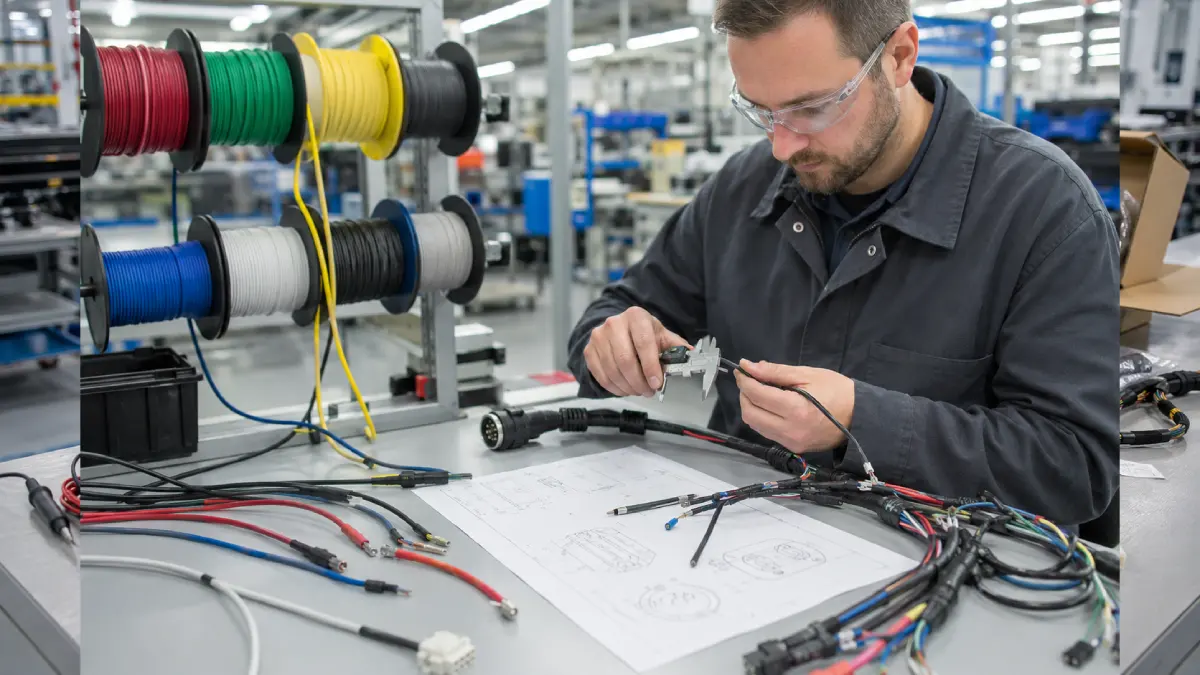
What to Confirm About Wire Gauge
- AWG size or metric cross-sectional area in mm².
- Rated current and operating voltage.
- Conductor material, such as bare copper, tinned copper, or aluminum, where applicable.
- Stranded or solid conductor structure.
- Required flexibility for fixed installation or repeated movement.
- Temperature rating and insulation material.
- Applicable standard, such as IEC, UL, SAE, ISO, or customer-specific specification.
For automotive or vehicle-related harnesses, road vehicle cable standards may define dimensions, test methods, and requirements for low-voltage and higher-voltage cable types. For industrial and power cable conductors, international conductor standards define nominal cross-sectional areas and resistance expectations. For appliance wiring material, UL-recognized wire may be required depending on the destination product and market.
| Wire Detail | Buyer Should Confirm | Supplier Should Provide |
|---|---|---|
| Conductor size | AWG or mm² based on current load and voltage drop requirement. | Wire specification sheet and approved equivalent options. |
| Conductor material | Bare copper, tinned copper, aluminum, or special conductor type. | Material declaration and supplier source information. |
| Temperature rating | Operating temperature range and nearby heat source exposure. | Insulation datasheet and rating evidence. |
| Flexibility | Fixed installation, moving equipment, bending area, or vibration zone. | Recommended strand structure and bend radius guidance. |
Recommendation: if your harness carries power, heating load, motor current, battery current, or charging current, confirm conductor size with engineering review before ordering. If your harness mainly carries low-current signals, confirm shielding, impedance, routing, and connector reliability more carefully. Different problems, different medicine.
Confirm Harness Length, Branch Length, and Tolerance
Length seems simple until two teams measure it differently. A custom cable harness may include a main trunk, multiple branches, connectors, sleeves, clips, labels, and installation bends. If the drawing does not define measuring points, the supplier may measure from connector end to connector end, wire exit to wire exit, centerline to centerline, or according to fixture position. A few millimeters may not matter for a loose appliance harness, but it can matter a lot for compact equipment, vehicles, robotics, control boxes, and battery systems.
Length Details to Confirm Before Ordering
- Total harness length and every branch length.
- Measurement reference point, such as connector face, wire exit point, or branch centerline.
- Allowed tolerance for each section.
- Minimum bend radius and routing path.
- Connector orientation and locking direction.
- Clip, grommet, cable tie, and mounting point position.
- Extra service loop or installation allowance if required.
If the harness will be installed inside a fixed product structure, create a harness board or fixture drawing. For complex OEM projects, the custom harness assembly supplier should use a production fixture that controls branch routing, length, and connector orientation. This is especially important when moving from sample to bulk production, as experienced technicians may adjust handmade samples, whereas mass production requires repeatable tooling.
Confirm Connector Brand, Part Number, and Approved Alternatives
Connectors are often the most underestimated part of a custom wiring harness. A connector is not just a plastic housing. It includes housing material, terminal compatibility, locking structure, sealing level, mating connector, current rating, temperature rating, insertion force, vibration resistance, and supply chain availability.
If you only specify “2-pin waterproof connector” or “white 6-pin plug,” suppliers may choose different models that look similar but perform differently. For OEM production, the connector brand and part number should be confirmed. If alternatives are allowed, the alternative approval rules must be written clearly.
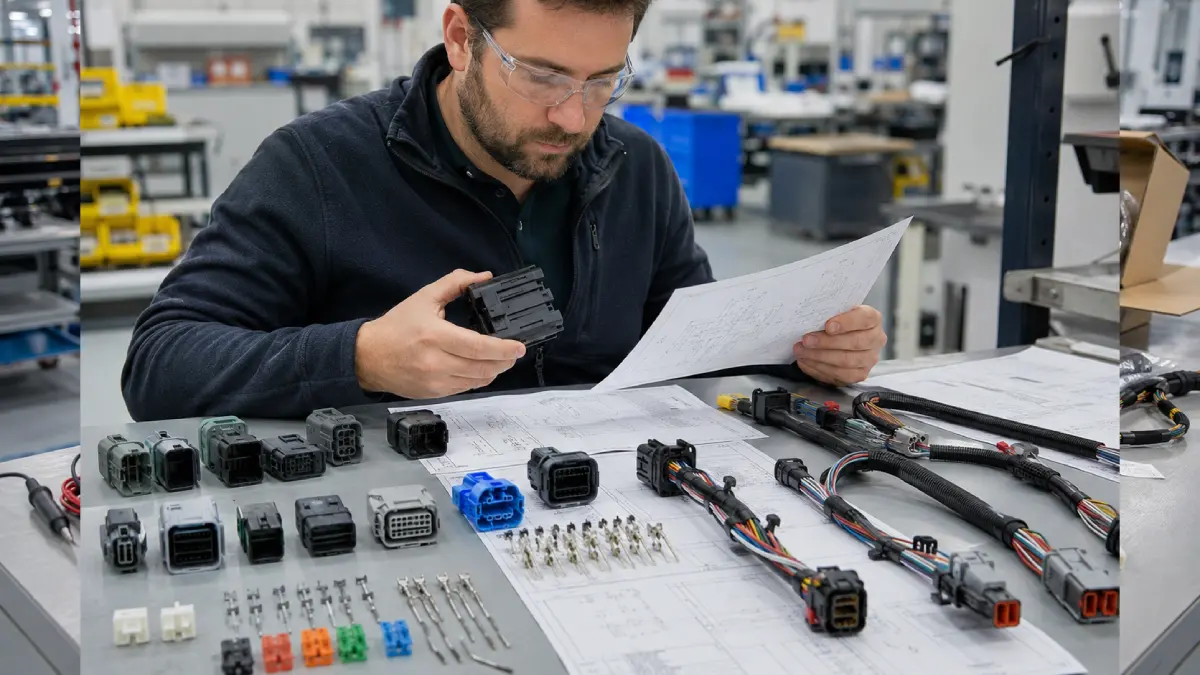
Connector Information You Should Provide
- Connector brand and exact part number.
- Mating connector information.
- Terminal part number and plating requirement.
- Seal, wedge, lock, backshell, boot, or accessory requirement.
- IP rating or waterproof requirement where applicable.
- Current rating, voltage rating, temperature rating, and vibration requirement.
- Approved equivalent brands or “no substitution without written approval.”
A reliable OEM wiring harness supplier should confirm whether the connector is available, whether tooling is required, whether genuine parts are needed, and whether local alternatives are acceptable. For export projects, buyers should also consider supply chain continuity. A low-cost unknown connector may reduce the unit price, but it can increase warranty risk, certification risk, and replacement difficulty.
| Connector Choice | When to Use | Buyer Risk |
|---|---|---|
| Original specified brand | Automotive, medical, safety-related, certified, or high-reliability products. | Higher cost and possible longer lead time. |
| Approved equivalent | Cost-sensitive OEM products where performance equivalence is validated. | Requires sample testing and written approval before bulk order. |
| Supplier-selected connector | Early prototype or non-critical application with flexible design. | Higher risk of mismatch, redesign, and inconsistent sourcing. |
Confirm Insulation, Jacket, and Environmental Resistance
Insulation material affects safety, durability, flexibility, flame resistance, chemical resistance, moisture resistance, and temperature performance. A custom wire harness used inside office equipment does not need the same insulation as a harness used in an engine bay, outdoor lighting system, agricultural machine, EV battery pack, marine device, or industrial robot.
Common Insulation and Jacket Factors
- Operating temperature and short-term heat exposure.
- Flame resistance requirements.
- Oil, fuel, acid, alkali, salt spray, moisture, or chemical exposure.
- UV resistance for outdoor applications.
- Flexibility for moving parts or repeated bending.
- Wall thickness and abrasion resistance.
- RoHS, REACH, UL, or customer-specific material restrictions.
PVC, XLPE, silicone, TPE, TPU, PTFE, FEP, and other materials may be used depending on the application. Do not choose insulation by habit. Choose it by the environment. For high-temperature or high-flex applications, the wrong insulation may crack, harden, melt, or fail prematurely. For products entering regulated markets, material compliance declarations should be confirmed before production.
Industry direction is moving toward safer materials, better restricted substance control, and clearer material documentation. RoHS focuses on restricting hazardous substances in electrical and electronic equipment, while REACH requires attention to substances of very great concern. For OEM buyers, this means the supplier should not only assemble harnesses; it should also manage upstream material information.
Confirm Harness Protection: Sleeves, Tubes, Tape, and Strain Relief
The protection system determines how the harness survives real installation and operation. A custom cable harness may need corrugated conduit, braided sleeve, PVC tube, heat shrink tubing, spiral wrap, fabric tape, adhesive-lined heat shrink, grommets, rubber boots, cable ties, clips, clamps, or strain relief parts.
Protection is not only about making the harness look tidy. It prevents abrasion, controls routing, reduces vibration damage, protects branch points, improves operator installation, and extends service life. If the harness passes electrical testing but fails mechanically after installation, the design is still not good enough.
Protection Selection Logic
| Application Condition | Recommended Protection | Why It Matters |
|---|---|---|
| Abrasion risk | Corrugated conduit, braided sleeve, protective tube. | Prevents insulation wear and exposed conductors. |
| Moisture or splash exposure | Sealed connectors, adhesive heat shrink, grommets, waterproof boots. | Reduces corrosion, leakage current, and connector failure. |
| Vibration environment | Clips, clamps, strain relief, locking connectors. | Prevents fatigue, loose terminals, and branch breakage. |
| Repeated movement | Flexible wire, bend control, soft sleeve, reinforced strain relief. | Improves life cycle performance under bending. |
When requesting a quotation from a custom harness assembly supplier, define not only what protection material is needed, but also where it starts, where it ends, and how it is fixed. A 20 mm difference in sleeve position may affect installation, appearance, or protection coverage.
Confirm Labeling, Color Coding, and Traceability Rules
Labeling is not decoration. It is a control system. Proper labels help workers install the harness correctly, help technicians service the product, and help quality teams trace batches when issues occur. For OEM projects, label content, position, material, printing method, barcode, serial number, and durability should be confirmed before ordering.
Labeling Details to Confirm
- Label content, such as part number, revision, circuit ID, batch number, serial number, or customer code.
- Label material, such as heat-shrink marker, wrap-around label, adhesive label, or printed sleeve.
- Print method, such as thermal transfer, inkjet, laser marking, or pre-printed label.
- Label position measured from a fixed reference point.
- Barcode, QR code, or serial number requirement.
- Resistance to heat, oil, moisture, abrasion, or cleaning chemicals.
- Packaging label and carton label requirements.
Color coding should also be written clearly. If wire color is used to support installation or circuit identification, the drawing should define exact colors and stripe requirements. For large-volume production, color substitutions must not be made casually. One wrong color can confuse assembly workers and turn a clean production line into a “guess the circuit” party. Nobody asked for that game.
Confirm Test Standards and Inspection Scope
Testing is where a custom wire harness proves that it is not only assembled but also functional. The inspection scope should match the application risk. A simple low-voltage harness may require continuity and visual inspection. A high-voltage, safety-critical, sealed, automotive, medical, or industrial harness may require additional testing and documentation.
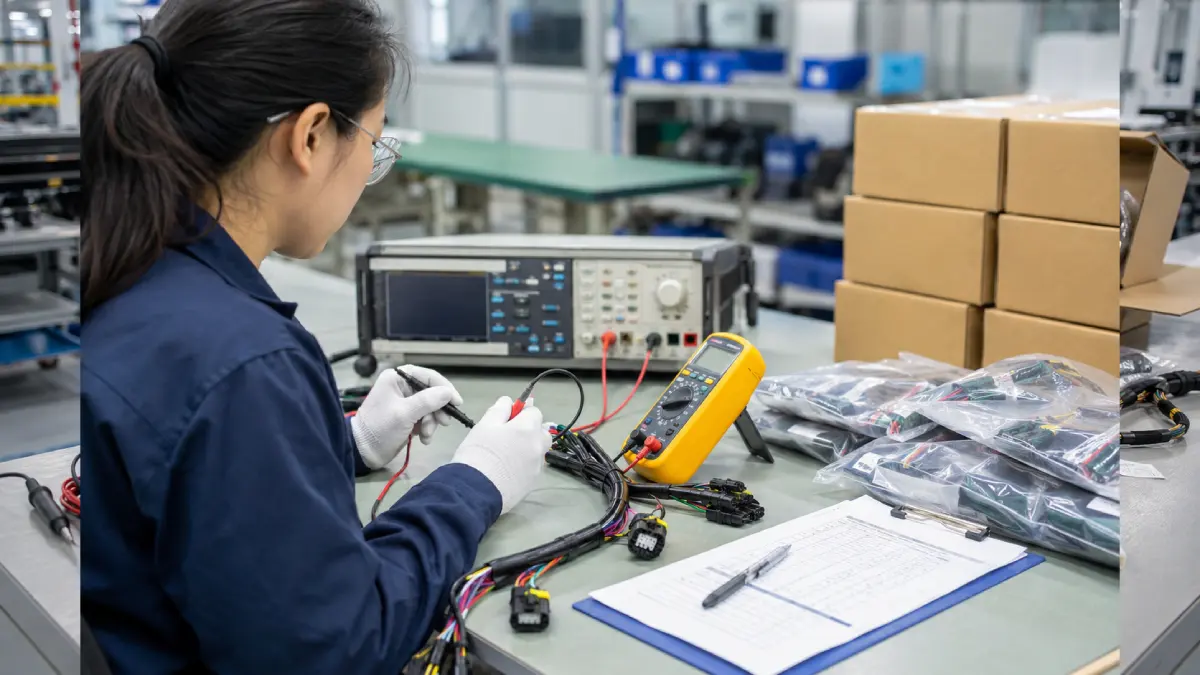
Common Wire Harness Tests
- Continuity test: Confirms that each circuit is connected correctly.
- Pinout test: Confirms that wires are inserted into the correct connector positions.
- Short-circuit test: Detects unintended connections between circuits.
- Insulation resistance test: Checks insulation performance between conductors or conductor and shield.
- Hi-Pot test: Applies higher voltage to verify dielectric strength where required.
- Pull-force test: Verifies crimped terminal mechanical strength.
- Crimp height inspection confirms crimp process control.
- Visual inspection: Checks labels, sleeves, connectors, terminal locks, branch routing, and appearance.
IPC/WHMA-A-620 is widely used as an acceptance reference for cable and wire harness assemblies. For automotive projects, customers may also request PPAP documents, control plans, FMEA, traceability records, and process validation. For appliance or electronic equipment projects, UL-recognized wire and RoHS or REACH declarations may be required depending on the product and market.
| Project Type | Minimum Test Recommendation | Additional Documents to Consider |
|---|---|---|
| Consumer appliance harness | Continuity, visual inspection, crimp pull-force sampling. | UL wire data, RoHS declaration, final inspection report. |
| Industrial equipment harness | Continuity, pinout, insulation resistance, label inspection. | Material traceability, QC report, test record, packaging confirmation. |
| Automotive wiring harness | Continuity, pinout, crimp validation, pull-force test, fixture inspection. | PPAP, control plan, FMEA, IMDS data, IATF-related process records. |
| High-voltage or battery harness | Continuity, insulation resistance, Hi-Pot, connector locking check. | High-voltage safety documentation, special handling instruction, batch traceability. |
Confirm Packaging Before the Harness Leaves the Factory
Packaging can protect or destroy a good harness. Long assemblies may be bent too tightly. Connectors may be crushed. Labels may rub off. Branches may deform. Moisture may affect terminals. Mixed part numbers may cause warehouse confusion. For international orders, packaging should be defined before shipment, not after production is finished.
Packaging Details to Confirm
- Individual bag or bulk packing.
- Coiling diameter and maximum bending limit.
- Connector protection, cap, foam, or separator requirement.
- Moisture protection or anti-static packaging if needed.
- Inner box quantity and outer carton quantity.
- Part number, revision, quantity, batch number, and barcode on carton labels.
- Pallet size, export carton strength, and shipping mark.
- Special handling instructions for fragile connectors or sealed assemblies.
For bulk order projects, ask the custom cable harness manufacturer to send packing photos before shipment. This simple step prevents many avoidable logistics problems. A harness that arrives tangled, bent, crushed, or mixed with the wrong part number is not a bargain. It is a box of future emails.
Confirm Compliance Documents for Your Target Market
Compliance requirements depend on the final product, industry, and destination market. A custom wire harness used inside an export appliance, EV charging device, vehicle system, medical machine, or industrial control cabinet may need material declarations, safety records, and component documentation. The supplier should understand whether it must provide RoHS, REACH, UL material information, IPC/WHMA-A-620 workmanship support, ISO 9001 quality records, or automotive-related documents.
In the EU market, restricted substance control is increasingly connected with circular economy goals and cleaner material cycles. For electrical and electronic equipment, RoHS focuses on hazardous substance restriction, while REACH SVHC tracking can affect plastics, insulation, adhesives, coatings, and other material inputs. In automotive and EV-related applications, closer attention to electrical safety and battery system integrity makes harness documentation more important.
Compliance Confirmation Checklist
| Requirement | When It Matters | What to Ask From Supplier |
|---|---|---|
| RoHS | Electrical and electronic products entering regulated markets. | Declaration, material test report, supplier statement. |
| REACH / SVHC | Products using plastics, sleeves, coatings, labels, adhesives, and export materials. | SVHC declaration and material compliance information. |
| UL-recognized wire | Appliance, electronic equipment, and North American market projects. | UL style number, wire datasheet, supplier certificate. |
| IPC/WHMA-A-620 | Workmanship acceptance for cable and wire harness assemblies. | Inspection criteria, training records, acceptance standard confirmation. |
| Automotive documentation | Vehicle, EV, battery, mobility, and transportation equipment projects. | PPAP support, control plan, traceability, IMDS data if required. |
Confirm MOQ, Lead Time, and Bulk Order Control
After technical details are confirmed, commercial details still matter. A custom harness assembly supplier should clearly state MOQ, sample lead time, mass production lead time, tooling cost, testing cost, packaging cost, connector lead time, and payment terms. For wholesale or bulk order projects, ask whether the supplier can maintain stable pricing and material availability over repeated orders.
Commercial Details to Confirm
- Sample cost and sample lead time.
- MOQ for custom harness production.
- Tooling or fixture cost if required.
- Connector and terminal procurement lead time.
- Mass production lead time at different order quantities.
- Annual demand forecast and possible safety stock plan.
- Quotation validity period and currency terms.
- Incoterms, shipping method, and export documentation.
If your demand is unstable, choose a supplier that can support flexible batch production. If your demand is stable and long-term, discuss forecast planning, component stocking, and repeat order pricing. If your product is still under development, do not lock a large bulk order before sample approval and pilot production. The cheapest mistake is the one you stop before mass production.
Common Mistakes to Avoid When Ordering a Custom Wire Harness
Mistake 1: Sending Only Photos Instead of Specifications
Photos help suppliers understand appearance, but they cannot define conductor size, pinout, terminal type, insulation rating, tolerance, or test requirements. Always convert visual information into drawings, BOMs, or written specifications before placing an order.
Mistake 2: Allowing Connector Substitution Without Approval
Similar-looking connectors may have different materials, terminals, locks, seals, or current ratings. If substitution is allowed, define approved brands and require written approval before sample or bulk production.
Mistake 3: Ignoring Length Tolerance
Without tolerance control, one batch may fit perfectly, and the next may create installation tension. This is especially risky for compact products, vehicle harnesses, battery systems, and equipment with fixed mounting points.
Mistake 4: Not Requiring Test Records
A supplier may test products internally, but if no records are provided, the buyer has limited evidence. For OEM projects, continuity test records, inspection reports, crimp pull-force data, and final QC reports help support quality control.
Mistake 5: Treating Packaging as “Supplier Default”
Supplier default packaging may not protect connectors, labels, branches, or long harnesses during export shipment. Define packaging clearly, especially for bulk orders and overseas delivery.
Recommended Ordering Workflow for OEM Custom Harness Projects
A controlled workflow reduces technical, quality, and delivery risk. The order process should not jump from quotation directly to mass production. For a serious OEM project, use a staged process: requirement review, quotation, sample, inspection, revision, pilot run, approval, bulk production, and shipment review.
Step-by-Step Workflow
- Send complete requirements: Provide drawing, sample, BOM, application details, quantity, and compliance needs.
- Request engineering review: Ask the supplier to confirm wire gauge, connectors, materials, tolerances, and manufacturability risks.
- Confirm quotation scope: Make sure the quote includes materials, testing, labeling, packaging, tooling, and documentation.
- Approve sample plan: Define sample quantity, test requirements, inspection report, and approval criteria.
- Review sample results: Check fit, function, electrical performance, label position, connector orientation, and packaging.
- Run pilot production: Use a small batch to verify process repeatability before full-scale production.
- Approve mass production: Lock the drawing revision, BOM, QC standard, and packaging rules.
- Check pre-shipment records: Review test reports, inspection photos, labels, packaging photos, and shipment documents.
Final Recommendation: Turn Every Assumption Into a Confirmed Specification
Buying a custom wire harness is not difficult when the order information is complete. It becomes risky when buyers and suppliers rely on assumptions. Before ordering, confirm wire gauge, length, connector brand, insulation, protection, labeling, testing, compliance documents, packaging, MOQ, lead time, and revision control. These details protect your project from installation problems, electrical failures, shipment delays, and expensive rework.
If your project is simple, a clear drawing and basic inspection checklist may be enough. If your project is complex, safety-related, or planned for bulk production, choose a custom harness assembly supplier that can support engineering review, sample validation, test records, material traceability, and stable repeat production. The best supplier is not the one that says “yes” fastest. It is the one that helps you confirm the right details before production starts.
FAQ About Ordering a Custom Wire Harness
1. What information is needed to order a custom wire harness?
To order a custom wire harness, you should provide a drawing, sample, wiring diagram, BOM, wire gauge, harness length, connector part numbers, pinout, insulation requirement, protection method, label details, test standard, order quantity, and packaging requirement. If you do not have a complete drawing, a professional custom harness assembly supplier can help review the sample and create a controlled specification before production.
2. How do I choose the right wire gauge for a custom wiring harness?
The right wire gauge depends on current load, voltage, operating temperature, voltage drop, installation length, flexibility, and safety margin. Power circuits usually need larger conductors than signal circuits. Before ordering, confirm AWG or mm² size with your engineering team and ask the supplier to provide wire datasheets, current rating information, and approved material options.
3. Can a supplier use alternative connectors for a custom cable harness?
A supplier can use alternative connectors only if the buyer approves them in writing. Alternative connectors must match the required pin count, terminal type, mating connector, current rating, voltage rating, temperature rating, locking structure, sealing level, and installation space. For OEM wiring harness projects, connector substitution should always be validated through samples and testing before bulk production.
4. What tests should be done before shipping custom wire harnesses?
Common tests for custom wire harnesses include continuity testing, pinout verification, short circuit testing, visual inspection, crimp pull-force testing, and connector locking checks. Depending on the application, insulation resistance, Hi-Pot testing, waterproof testing, or functional testing may also be required. Buyers should confirm the test standard and request inspection records before shipment.
5. Why is labeling important for custom harness assemblies?
Labeling helps identify part numbers, circuit positions, installation points, batch numbers, revision levels, and traceability information. Clear labels reduce assembly errors, support maintenance, and help quality teams investigate problems quickly. For bulk OEM orders, label content, position, material, printing method, and barcode requirements should be confirmed before production.
6. What packaging is best for custom wire harness bulk orders?
The best packaging depends on harness size, connector fragility, branch structure, label durability, and shipping distance. Bulk orders may need individual bags, connector protection, controlled coiling diameter, carton separation, moisture protection, barcode labels, and export cartons. Good packaging prevents crushed connectors, bent branches, label abrasion, mixed part numbers, and installation problems after delivery.
7. Should I approve a sample before mass production?
Yes, sample approval is strongly recommended before mass production. A sample allows you to confirm harness length, connector fit, pinout, wire gauge, insulation, labels, protection, packaging, and electrical testing. For OEM projects, sample approval should be supported by inspection reports and any required test records so that the approved design can be repeated in bulk production.
8. How can I reduce risk when buying custom wire harnesses from China?
To reduce risk when buying custom wire harnesses from China, choose a supplier with real factory capability, engineering support, clear quotation details, sample validation, QC records, material traceability, compliance documents, and export packaging experience. Confirm all technical specifications before ordering and avoid comparing suppliers only by unit price.
Reference
- European Commission. “Restriction of Hazardous Substances in Electrical and Electronic Equipment.” European Commission, Environment.
- European Chemicals Agency. “Candidate List of Substances of Very High Concern for Authorisation.” ECHA CHEM.
- IPC and WHMA. “IPC/WHMA-A-620F: Requirements and Acceptance for Cable and Wire Harness Assemblies.” IPC Electronics.
- UL Solutions. “Appliance Wiring Material Testing and Certification to ANSI/UL 758.” UL Solutions.
- International Electrotechnical Commission. “IEC 60228:2023 Conductors of Insulated Cables.” IEC Webstore.
- International Organization for Standardization. “ISO 6722-1: Road Vehicles — 60 V and 600 V Single-Core Cables.” ISO.
- National Highway Traffic Safety Administration. “FMVSS No. 305a: Electric-Powered Vehicles, Electric Powertrain Integrity.” Federal Register.
- International Automotive Task Force. “IATF 16949 Automotive Quality Management System Standard.” IATF.
- Automotive Industry Action Group. “Production Part Approval Process and Advanced Product Quality Planning References.” AIAG.
- Fortune Business Insights. “Automotive Wiring Harness Market Size, Share and Industry Analysis.” Fortune Business Insights.